Any team works fine when things are calm. What matters is how it works when pressure hits.
We measure how your team decides, disagrees, and delivers under pressure. You get two reports (one per person and one for the team) and an AI, Tigo, that helps you dig deeper into them.
Why take the risk? Find the signal before the noise arrives.
Five brilliant people can still form a team that gets stuck.
What decides it isn't each profile on its own. It's how they fit together under tension.
An example
Picture a team where everyone scores high on collaboration. On paper, ideal. But that closeness might rest on avoiding friction: nobody wants to be the one who breaks the good mood. While things go well, it doesn't show. But when things get complicated, the uncomfortable thing doesn't get said in time, and the problem surfaces once it's too late to fix.
Profiles can fit together. Tension reveals whether the team actually works.
What the report does
Predict how your team behaves under pressure.
We do it in two steps:
Analysis of 5 competencies. Each person (and the team as a whole) gets a score across five competencies. It's calculated by a validated method with fixed rules (a deterministic process).
Tigo looks for patterns. Based on those scores and the risk patterns it detects, Tigo estimates how the team tends to behave under pressure (a probabilistic model).
Smartest · Team report
The team report.
What you get
Two reports: each person, and the team as a system.
They don't replace each other — they complement each other. The individual report helps you understand each person; the team report shows how the group works.
For each person
Individual report
Each member's profile across the five competencies: what they bring to the team, where they might need more support, and how they change when pressure hits.
Their profile across the five competencies
What they bring, and where they might need more support
How they change under pressure
TIGO ANSWERS
Here, Tigo answers your questions about the report and helps you interpret it.
The team as a system
Team report
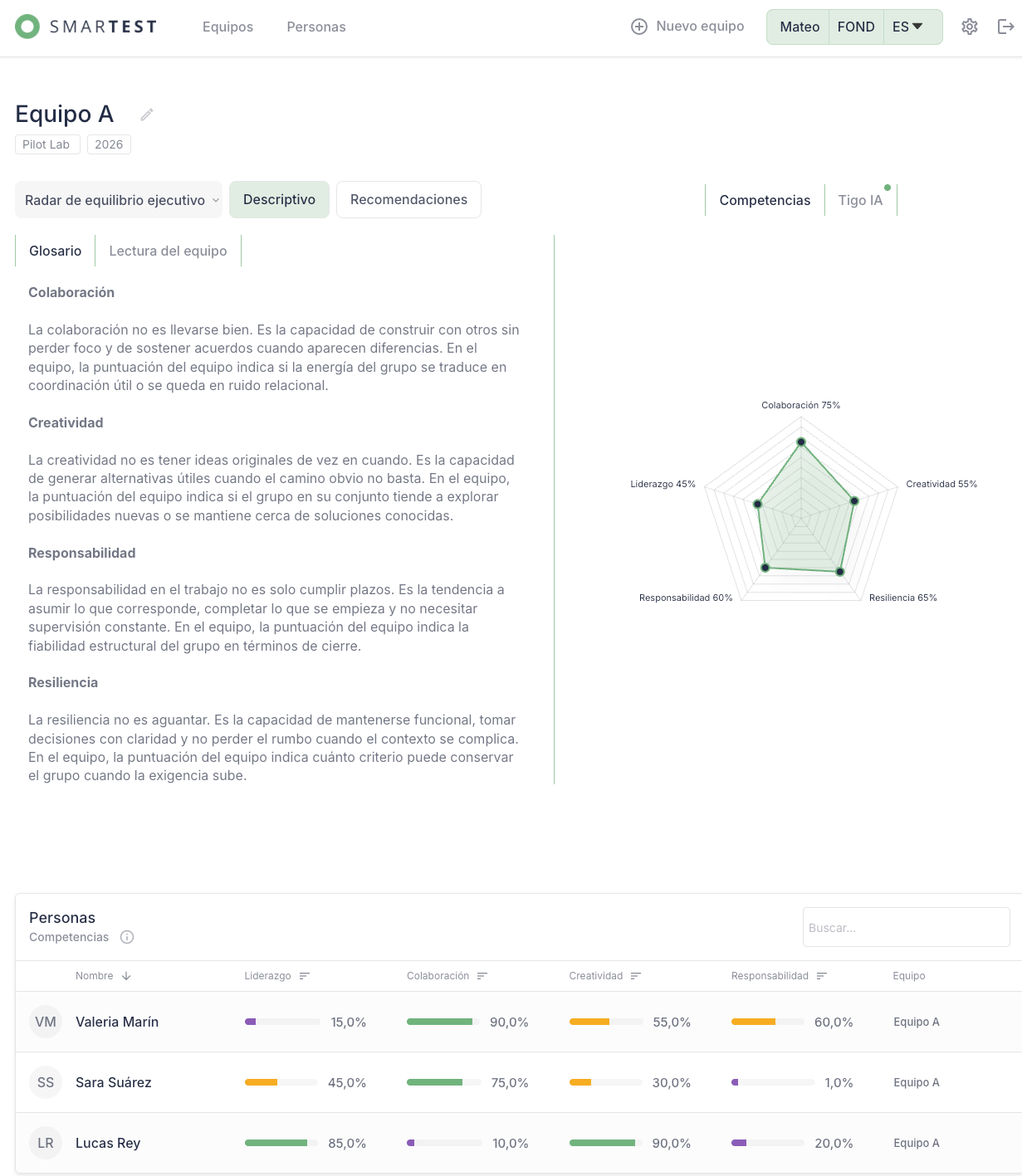
Here we analyze the team as a system. We see what doesn't show up in individual profiles: how the five competencies combine, and which risk patterns can activate under pressure.
A collective read of each competency
Risk pattern detection
Tigo's proactive analysis
TIGO PROACTIVEPATTERNS
Here, Tigo doesn't wait for you to ask: it analyzes the report as soon as you open it, and if it detects a relevant pattern, it shows it to you.
Competency
A specific capability
Collaboration, resilience, or leadership, for example. Each one appears in both reports, with its own score.
Pattern
What happens when they combine
What shows up when several competencies intersect in a certain way across the team. For example, high collaboration with low resilience. It's only detected in the team report.
You decide who sees what
Smartest (our platform) lets you assign access permissions to each person, so you decide exactly what they can see: only their own report, authorized reports from others on their team, the team report, every report in the company, or no report at all if they only take part in the assessment.
The AI · Tigo
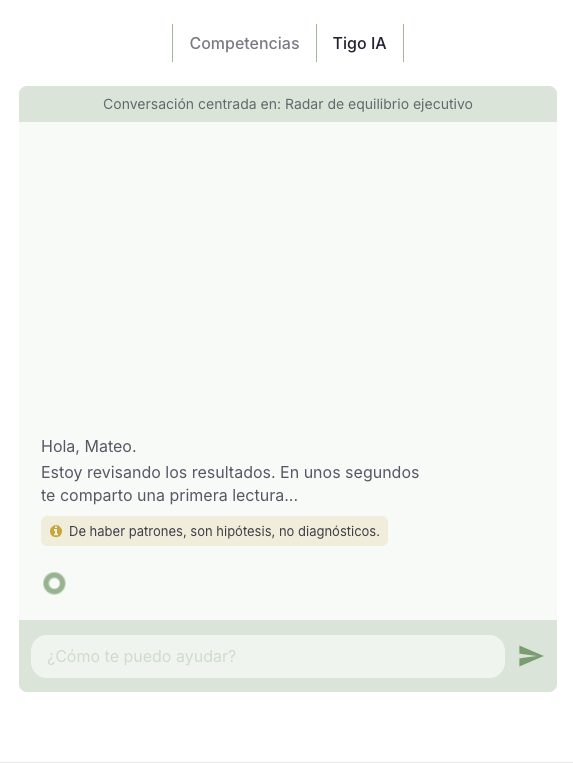
You open the team report, and Tigo is already reading it.
The first thing Tigo does when you open the team report is read it end to end and look for patterns. If it finds one, it shows it to you. And if it doesn't find any relevant pattern, it tells you that too: it can be a sign of balance in the team, and it invites you to explore its competencies in more detail.
That's the idea: nothing important should go unnoticed just because you didn't know where to start.
Smartest · Team report
Tigo analyzing the team report.
A sparring partner, not an oracle
Tigo does what a good sparring partner would: tells you what it sees, explains what it's based on, and leaves the decision to you.
Tells you what it saw, no embellishment.
Separates what's data (the scores) from what's its own read.
If no pattern shows up, that can be a good sign. In that case, Tigo invites you to move on to reviewing the team's competencies.
You choose where to go next. Tigo opens the conversation; you steer it.
What we measure
Five competencies, and how the team responds under pressure.
In calm conditions, almost every team looks like it's working well. The difference shows up when pressure hits and you no longer get to choose the moment. That's what we measure: how the team responds.
01
Leadership
It's not about who's in charge. It's the ability to set direction, decide, and get others moving. When pressure hits, you can tell whether the team has someone setting the course, or whether decisions just hang in the air.
Under pressure: is there someone setting the course and deciding, or do decisions hang in the air?
02
Collaboration
Careful — this isn't about getting along. A team can be perfectly friendly and still collaborate badly. Real collaboration means being able to say the uncomfortable thing in time, having the other person actually listen, and having the relationship survive afterward. That's usually the first thing to break under tension.
Under pressure: can the uncomfortable things be said, and does the relationship survive?
03
Creativity
We're not talking about brilliant ideas on a whiteboard. We're talking about finding another way out right when the obvious path stops working. The hard part isn't having ideas: it's knowing when to change course.
Under pressure: does the team change course, or does it freeze looking for the perfect answer?
04
Accountability
Owning what's yours and closing what you start, without anyone having to stay on top of you. It sounds basic, but it's exactly what separates a team that delivers from one that always has a good reason for not having done it yet.
Under pressure: does the team deliver, or does it always find a good reason not to?
05
Resilience
Staying functional and clear-headed when things get complicated. And this is usually where an important gap shows up: the distance between how the team sees itself and how it actually works. In calm conditions, everyone looks resilient — until it's time to prove it.
Under pressure: can the team keep a steady, balanced performance?
An example
This is how Tigo detects a pattern.
This is one of the patterns Tigo can detect. Here's how.
Slow decisions
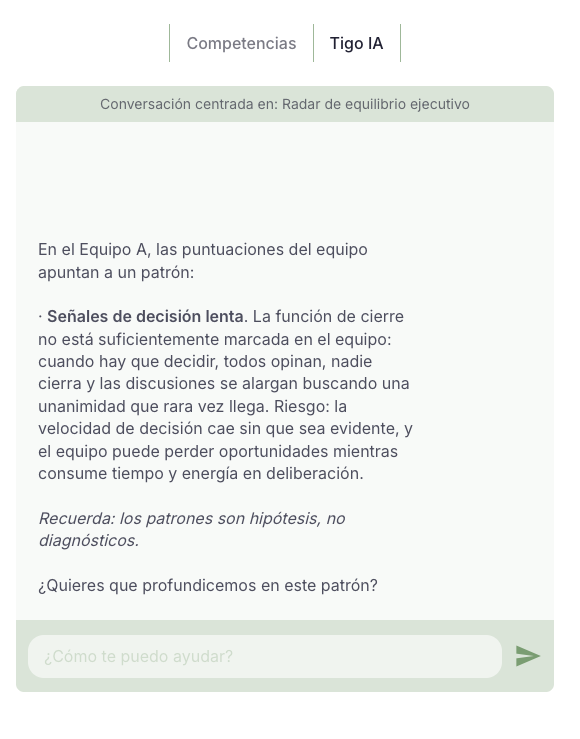
When no one owns decision-making, everything ends up being decided as a group: every decision takes one extra loop, and — without anyone saying so — it starts requiring everyone to agree before moving forward. The team isn't deciding badly. It's deciding late. And no one chose it that way: it happened gradually, without anyone noticing.
1It sees it in the data. In the team report, leadership and follow-through show up low, or without a clear owner.
2It names the pattern. Tigo flags it, explains the mechanism and the risk: decision speed drops without anyone noticing.
3It hands it back to you. It marks it as a hypothesis, not a diagnosis, and asks if you want to dig deeper.
"Waiting to decide can be more dangerous than being wrong: bad decisions can be corrected; lost time can't."
Paraphrased from ideas by Chris Van Dusen, Solyco Capital. Bain also finds a 95% correlation between excelling at decision-making and execution, and achieving top-tier financial results.
Smartest · Pattern detected
Tigo detects a pattern in a team's report.
This is just one example: the list of patterns Tigo recognizes keeps growing as we refine the model.
The individual report
A smart read on objective data.
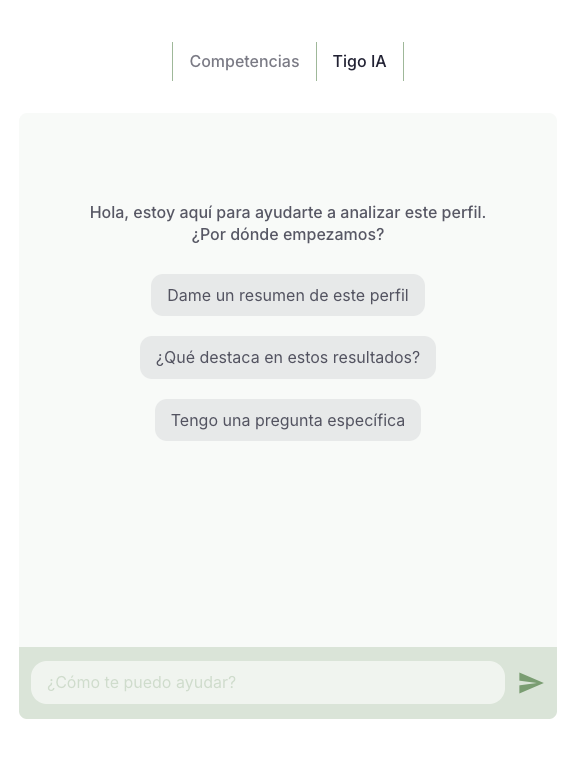
In the individual report, Tigo starts from each person's scores and helps you dig into the most relevant competencies: what they mean, what stands out, and what's worth a closer look.
Smartest · Individual report
Analyzing another team member's report.
Start here
See how your team works under pressure, before the pressure arrives.
In calm conditions, any team looks like it's working. What really matters only shows up under pressure. See it before it happens.