The whole market acts once the sick leave already exists. Retention and Engagement sits one layer earlier: it estimates each person's risk from their competencies, not their history, and tells you what to do with each profile.
With special attention to emotionally driven absenteeism: the kind that's growing fastest.
How many people were absent, how many days, how much it cost: all of that describes the past. The useful question is a different one: who concentrates the risk right now.
What the sick note doesn't show
An unplanned absence never comes alone: a shift that gets rearranged, a colleague who carries more, an improvised substitution, a hire that got expensive before it started performing. The sick note records the leave. The real cost spreads, quietly, across the whole team.
You can’t see it comingA flu. An injury.
Health gives no warning, and no method predicts it.
You canDisengagement.
It follows a pattern that can be measured before the first absence.
Sick notes tell you what already happened. The pattern was there before.
What the report does
Estimate each person's absenteeism risk.
We do it in three steps:
A short test. Each person completes a roughly six-minute assessment in Smartest, our platform, with our own scientifically grounded instrument.
Five competencies with fixed rules. The test translates into five competencies scored from 0 to 100, calculated by a validated method with fixed rules (a deterministic process).
A management read for each person. For every risk level, the report delivers concrete recommendations written in plain language for the team lead. The value is in the management text, not in the number.
Smartest · Retention and Engagement
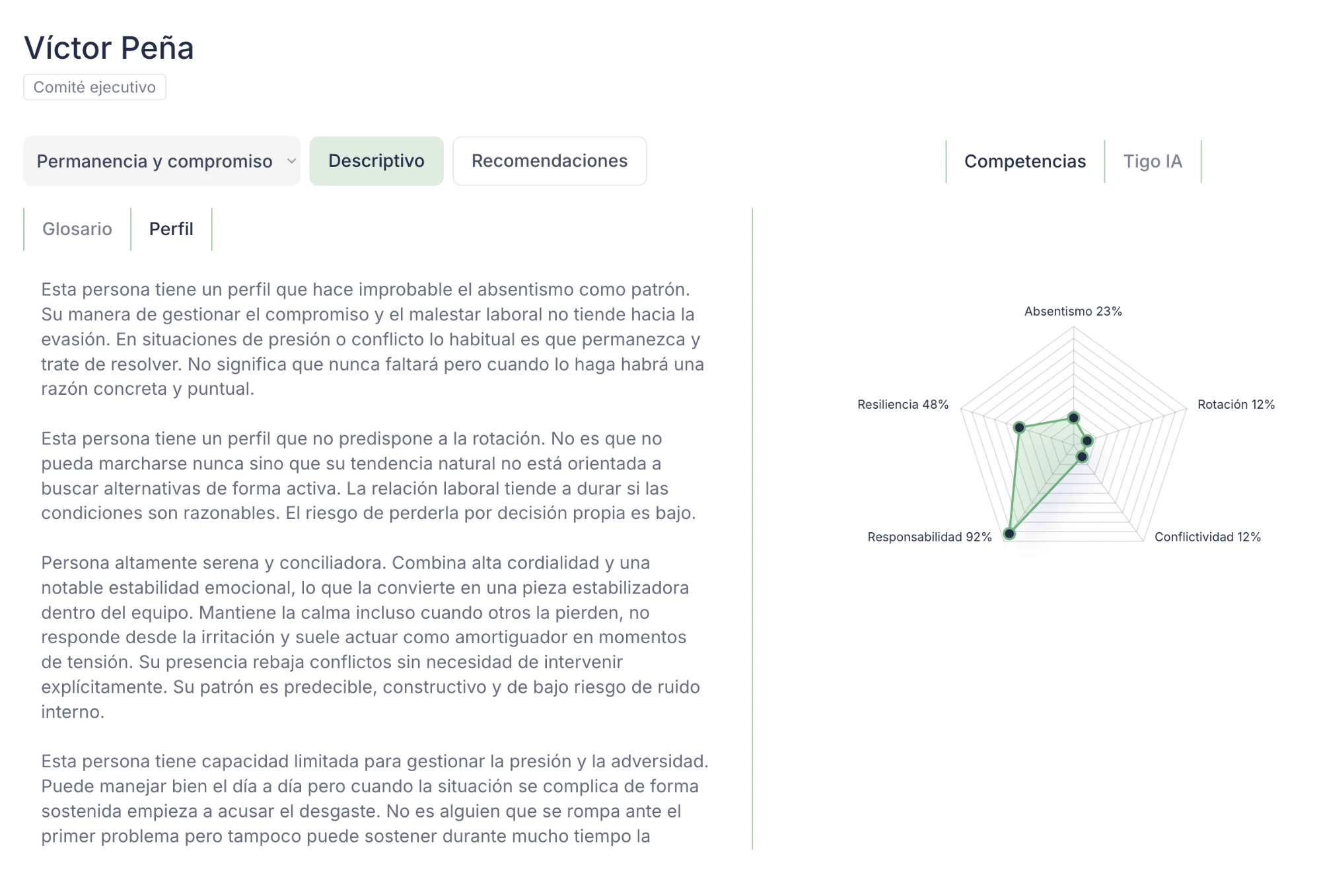
Retention and Engagement, inside the platform. Demo-account screenshot (interface in Spanish): we never show client data.
What you get
A dynamic report per person, with a read and an action.
It's not an isolated risk score. Each person gets a score across five competencies and, above all, concrete recommendations on how to manage them.
The data
The score
Where each person sits in each of the five competencies.
A 0–100 score per competency
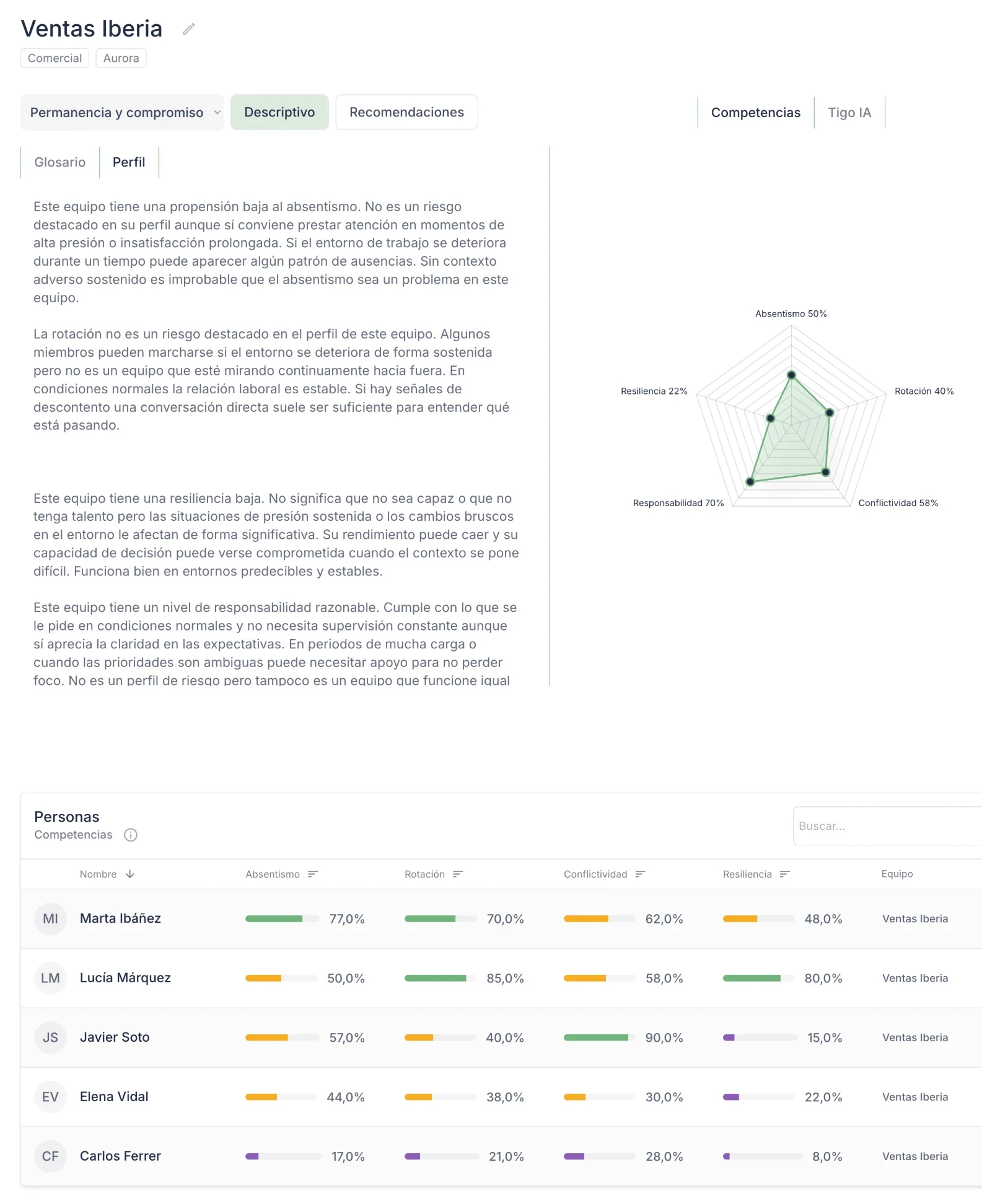
Each person's risk level, at a glance
A descriptive profile of the person
TIGO ANSWERS
Tigo, the platform's AI, answers your questions about each report and helps you interpret it.
What's really worth it
The management read
For each person, the report explains what to do: it doesn't stop at flagging the risk: it hands you the lever.
How to manage them day to day
What to do on retention and medium-term development
Written in plain language for the team lead
MANAGEMENTEVOLUTION
The number tells you where to look. The text tells you what to do.
Smartest · Retention and Engagement
A demo-account team, inside the platform (interface in Spanish): every person with their score and level at a glance. We never show client data.
From the report itself · high-absenteeism bracket
"This person is going to be absent. It's not a matter of if, but of when and how often." And then, the part that matters: how to design the role so their work isn't a single point of failure, how to talk to them when they're absent, without drama, and which levers (belonging, feeling useful) move this profile more than rules do.
A report for managing, not for singling out
The report estimates a risk: it is not a medical diagnosis, nor a certainty about anyone. Its proper use is managerial (selection, role design, support, and retention), within the framework of data protection and non-discrimination. In Smartest, you decide with access permissions who can see each report.
What it measures
The five competencies in the report.
Absenteeism as a pattern doesn't come out of nowhere: it lives in how each person handles commitment, pressure, and discomfort. The report measures it alongside the four competencies that explain it best.
01
Absenteeism
The central competency: the likelihood that a person resorts to absence, excused or not, as a habitual response when work gets tough or motivation drops.
The question: who tends to be absent when things get difficult?
02
Turnover
The likelihood that a person ends up leaving. Absenteeism and turnover tend to travel together: the same disengagement that is an absence today is a departure tomorrow, with its hiring and ramp-up cost.
The question: who is closer to leaving than they seem?
03
Resilience
Endurance under pressure: how well the person stays functional when things get complicated. Low resilience turns rough patches into absences.
The question: who rides out a rough patch, and who turns it into an absence?
04
Accountability
Self-demand and follow-through: showing up, delivering, and closing what you start without anyone having to stay on top of you. It's the natural counterweight to absenteeism.
The question: who shows up even when the day doesn't help?
05
Conflict
Friction with colleagues or managers: clashes that repeat, tension that never gets resolved and that the team ends up noticing. High conflict wears down a person's relationship with their work, and that wear turns into absence too.
The question: who's carrying a friction nobody has resolved?
The validation
Validated with blind tests.
The method is always the same: the company picks a group and knows who is absent; Fond doesn't. A roughly six-minute test per person, a blind analysis and a final session comparing the report's read with the reality the company knew. A full test fits in one week. And framing matters: anticipating risk is for caring and organizing better, not for surveillance.
Test 1 · Spanish edtech startup
101 people, 8 known absentees
A successful Spanish edtech startup put the report to the test with 101 people from its workforce. The report ranked them from highest to lowest estimated absenteeism risk, without knowing anyone's history. The company did know who was absent: 8 people. When the two lists were compared, all eight absentees sat in the top part of the ranking, within the first 39 positions. Among the remaining 62, not one.
The 101 people, ordered by estimated riskThe 8 absentees the company knew about
The real result of the test. To the right of the dotted line: 62 people, not a single absentee.
Where the report marked low risk, not a single case appeared. That is the other half of the value: knowing who you can build on, for example during a hiring process.
Test 2 · Large industrial company
The two highest-risk people were already on sick leave
The administrative department of a large industrial company. Each person completed the test a few days before a training course, and the algorithm was applied without knowing anyone's history. The two people with the highest absenteeism scores in the whole ranking never made it to the course: they had gone on sick leave the week before. It only came to light when the data was compared.
The nine people from the test, by absenteeism score (0 to 100). In maroon, the two who were on sick leave.
The other report
Asking a different question? We also publish the Executive Balance Radar: how your team decides, disagrees, and delivers when pressure hits.
Within one or two business days we'll email you the demo account credentials and brief instructions to explore it.
What's next
What happens when you request it
A real person from Fond writes to you, not an automated system, with your demo account credentials and brief instructions.
You explore Retention and Engagement with sample teams. Your demo account also includes the Executive Balance Radar: every team and every person has both.
You see how it would work across your workforce; no internal project required.
For any company determined to predict and prevent absenteeism.